Frequently Asked Questions
-
NOAA offers this definition:
In citizen science, the public participates voluntarily in the scientific process to address real-world problems. This may include forming research questions, conducting scientific experiments, collecting and analyzing data, interpreting results, making new discoveries, developing technologies and applications, and solving complex problems. This work is synonymously called community science and participatory science.
SciStarter is another good resource: https://scistarter.org/citizen-science
-
“Because the ocean is the cornerstone of earth's life support system, it shapes climate and weather. It holds most of life on earth. 97% of earth's water is there. It's the blue heart of the planet — we should take care of our heart. It's what makes life possible for us.
Even if you never have the chance to see or touch the ocean, the ocean touches you with every breath you take, every drop of water you drink, every bite you consume. Everyone, everywhere is inextricably connected to and utterly dependent upon the existence of the sea.”
Dr. Sylvia A. Earle, Her Deepness
-
Plankton is an ecological definition that encompasses any marine organism that drifts with ocean currents and cannot actively swim.
Phytoplankton are microscopic plant-like organisms that use sunlight and chlorophyll to make their own food via photosynthesis, converting carbon dioxide into energy while releasing oxygen. While they act like plants, they are technically a diverse group composed of single-celled algae, protists, and bacteria.
Diatoms, one of the most abundant types of phytoplankton, are algae that live in houses made of glass. They are the only organism on the planet with cell walls composed of transparent, opaline silica, which forms intricate and striking patterns.
Scientists have officially described and cataloged roughly 20,000 to 25,000 species across eight major taxonomic groups, though there are likely over 100,000 different species of phytoplankton.
Phytoplankton produce half the air we breath, absorb nearly a third of all carbon emissions (and are therefore critical to regulating global climate), and are the base of the marine food chain. All life on Earth depends on phytoplankton.
https://science.nasa.gov/earth/earth-observatory/what-are-Phyoplankton/
-
Zooplankton are microscopic animals, the young of larger invertebrates and fish, and weak swimmers like jellyfish. Krill may be the most well-known type of zooplankton.
Zooplankton are organized by how much of their life cycle they spend drifting. Holoplankton are organisms that remain plankton for their entire lives; for example, jellyfish. Meroplankton are organisms that only float as plankton during their early, vulnerable life stages—typically as eggs or larvae.
During the daylight hours, zooplankton generally drift in deeper waters to avoid predators. At night, these microscopic creatures venture up to the surface to feed on phytoplankton. This process is the largest animal migration on Earth and can be observed from space.
Plankton are incredibly important to the ocean ecosystem, and very sensitive to changes in their environment, including the temperature, salinity, pH level, and nutrient concentration of the water. Because many zooplankton species eat phytoplankton, shifts in timing or abundance of phytoplankton can quickly affect zooplankton populations, which then affects species along the food chain.
Most zooplankton eat phytoplankton, and are, in turn, eaten by larger animals (and by each other), including blue whales, the largest animals on Earth.
https://www.whoi.edu/ocean-learning-hub/ocean-topics/ocean-life/jellyfish-other-zooplankton/
-
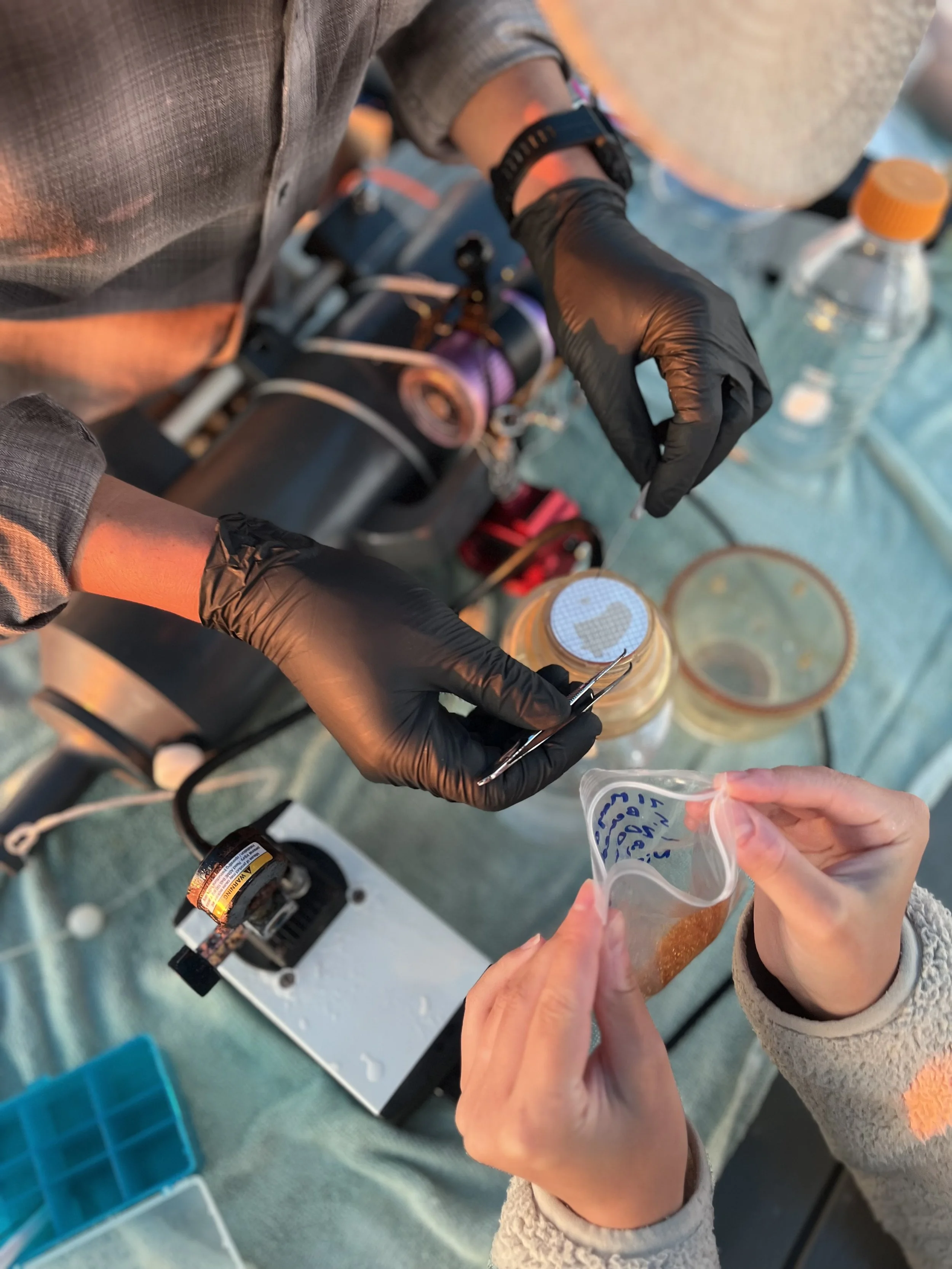
Environmental DNA (eDNA) is genetic material collected from the environment that has been shed by organisms in the water column. By collecting water samples, scientists can process eDNA to make new discoveries about marine life.
eDNA is an emerging technology that helps answer many questions such as what species are present in a particular location, what the biodiversity of the area is, and if any invasive or endangered species are present. eDNA can identify these organisms and characterize their role in the area’s food web and ecosystem. DNA barcoding has even been used to link larvae to their adult organisms that were previously thought to be separate species because of their appearance differences. eDNA can be used to monitor water quality harmful bacteria, and commercial fisheries use it to inform their location selection and fishing practices.
eDNA also has many benefits that complement traditional sampling efforts. eDNA does not require interacting with living organisms, making it a non-invasive sampling technology. It can also offer a window into the lives of organisms that have not been captured on video or may ordinarily shy away from the lights of a remotely operated vehicle or that are too small to observe. eDNA can detect a wide diversity of marine life, from bacteria to vertebrates, greatly expanding the scope of an expedition.
-
Yes! Earth Watch and Biosphere Expeditions offer citizen science expeditions. Some private research institutes offer opportunities to join scientists in the field. Here are just a few:
Marine microplastics: https://www.sailandexplore.com/
Marine megafauna in Mozambique: https://marexpeditions.com/
Coral reef rescue expeditions in the Bahamas: https://www.perryinstitute.org/reef-rescue-network-expeditions/
Pioneering exploration to discover new species in jungle ecosystems: https://taxonexpeditions.com/
Studying sharks in the Bahamas: https://www.savingtheblue.org/
Whale shark conservation in the Maldives: https://maldiveswhalesharkresearch.org/
Tropical marine research in Central America: https://maralliance.org/
Conservation marine research in Indonesia: https://indooceanproject.org/
Grassroots, community-based marine conservation in Mozambique: https://lovetheoceans.org/
Conservation and sustainable tourism in Iceland: https://oceanmissions.org/
Scientific training program in Mozambique: https://bcssmz.org/